Our Story
We put life-saving tools where they're needed most.
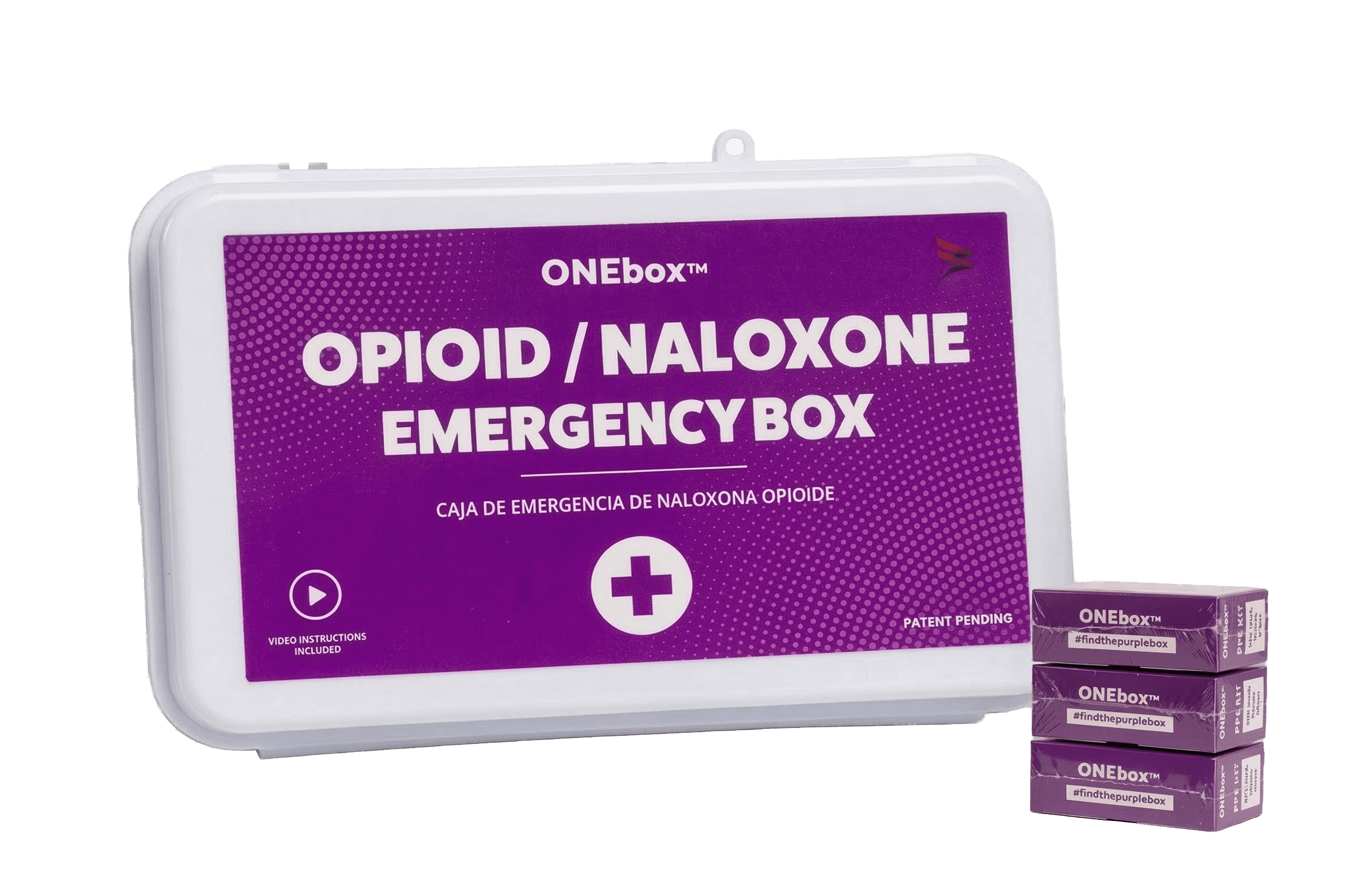
Rapid Risk Reduction (R3) builds emergency response stations for the person who is already in the room. Not the paramedic who is eight minutes out, and not the one employee who took a class last spring. Whoever is standing closest. The ONEbox® puts the naloxone you supply, protective gear, and a one-minute bilingual video in one box, so that person can open the lid and act.
See It In Action
Every configuration plays the same one-minute video. The difference is where it lives.
ONEbox® Classic
The flagship station. A wall-mounted or portable box with a built-in 5-inch bilingual video screen, three PPE kits, written instructions, and secure storage for the naloxone you supply.
View productONEbox® Colocation
A 3-inch bilingual video screen and two PPE kits on adhesive-backed Velcro dots, made to sit beside the AED cabinet or first aid kit you already own. The naloxone and the instructions end up in the same place.
View productONEbox® Flex
The same weather-sealed box without the screen. A QR code opens the video on any phone, which makes it the right kit for outreach teams, mobile units, and events. Naloxone not included.
View productWho We Serve
Sectors
Schools & universities
Discreet stations for residence halls, student unions, libraries, and athletic facilities, installed where ADA accessibility guidance puts them: visible, reachable, unlocked. Students, staff, and visitors all get the same one-minute walkthrough.
Libraries & public spaces
Community gathering points serve everyone, which means they serve people at risk. A ONEbox® at the desk or by the restroom gives staff and patrons the same tool and the same instructions.
Workplaces & warehouses
Opioid response and heat safety kits that hang beside the AED and the first aid cabinet, so a coworker can act in the first minutes and the safety program covers what actually happens on a shift.
Government & grant-funded programs
Transparent pricing, bulk ordering, and audit-friendly documentation for county and state rollouts, plus free consultation on placement, naloxone sourcing, and training, from the first call through the first restock.
The Mission
Every second matters.
Every box is a chance.
An opioid overdose does not wait for the ambulance. Breathing slows, then stops, and the person who can change the outcome is usually a bystander with no training and no time. In a CDC study of overdose deaths across 24 states and the District of Columbia, 37% happened with someone else present [2]. The ONEbox® was built for that someone. The lid opens, the video starts, and within a minute they know to call 911, give the naloxone inside, and stay until help arrives. A training mode lets a team practice before it ever matters.
The country is making progress. CDC provisional data predict 67,798 drug overdose deaths in the 12 months ending March 2026, a 12.3% decrease from the year before [1]. That is still roughly 185 people a day, each of them somewhere a box could have been.
In Wilson County, North Carolina, the local substance prevention coalition began placing ONEbox kits at more than 60 sites in early 2024 [4]. Its director reported that the county's overdose fatality rate fell 61.5% from 2023 to 2024 [3]. We do not promise that number to anyone. We promise the same box, the same video, and the same support.
Ready to protect your community?
Whether you need a single unit or a full county deployment, we'll match the configuration, the pricing, and the support to your sites.
Or email us directly at support@rthree.io
Sources
- Centers for Disease Control and Prevention. (2026, August 31). CDC launches new Overdose Prevention Data Channel [Press release]. https://www.cdc.gov/media/releases/2026/cdc-launches-new-overdose-prevention-data-channel.html
- O'Donnell, J., Gladden, R. M., Mattson, C. L., et al. (2020). Vital signs: Characteristics of drug overdose deaths involving opioids and stimulants, 24 states and the District of Columbia, January to June 2019. MMWR Morbidity and Mortality Weekly Report, 69(35), 1189 to 1197. https://www.cdc.gov/mmwr/volumes/69/wr/mm6935a1.htm
- Ellis, M. (2025, June 13). Naloxone vending machines met with high demand in Wilson County. CBS17 (WNCN). https://digital-release.cbs17.com/news/local-news/naloxone-vending-machines-met-with-high-demand-in-wilson-county/
- Baxley, J. (2024, April 18). Wilson County deploys overdose reversal kits to combat epidemic of opioid deaths. North Carolina Health News. https://www.northcarolinahealthnews.org/2024/04/18/wilson-county-deploys-overdose-kits/